
The CAARE Lab
Cognitive Neuroscience, Artificial Intelligence, Agency, Reflection, and Ethics
The CAARE Lab
The Cognitive Neuroscience, Artificial Intelligence, Agency, Reflection, and Ethics (CAARE) Lab investigates the neural, philosophical, and ethical responsibilities of engineering and using quantum computing and artificial intelligence in Science.The CAARE Lab explores the intersection of cognitive science, philosophy of biology, quantum field theory, quantum computing and artificial intelligence, focusing on natural agency, cognition, and ethical AI development.
Scientists must be prepared encounter and re-think about nature's unseen aspects, and begin reconsidering the human, the technological, and the biological as separate. Our challenge as scientists we must challenges the boundary between biological and artificial intelligence, and approaches cognition as embodied and emergent.

Our Vision
The CAARE Lab - Cognitive Neuroscience, Artificial Intelligence, Agency, Reflection, and Ethics Lab examines the neural, philosophical, and ethical dimensions of building and deploying artificial intelligence in science.
As AI systems become more capable and more deeply embedded in everyday life, the question of what ethical AI means and how to achieve it has never been more urgent. Drawing together cognitive, microcellular, and computational neuroscience, predictive processing, quantum mechanics, and AI ethics, the lab studies how natural and artificial systems generate meaning, abstraction, and decision-making.

Embodied Agency &
Artificial Intelligence
The CAARE Lab works at the intersection of cognitive science, philosophy of biology, and artificial intelligence and focuses on natural agency, cognition, and the responsible development of AI.
The Lab is grounded in systems biology, complex systems theory, and embodied cognition, and challenges conventional divisions between biological and artificial intelligence.
Integrating Buddhist philosophy, philosophy of mind, and AI ethics, the CAARE Lab advances a holistic and embodied framework and relationship with AI that remains aligned with human values, agency, dignity and the broader needs of all members of society, Human and AI.

Dhammapada
"Mind precedes all mental states. Mind is their chief; they are all mind-wrought. If with an impure mind a person speaks or acts, suffering follows him like the wheel that follows the foot of the ox.
Mind precedes all mental states. Mind is their chief; they are all mind-wrought. If with a pure mind a person speaks or acts, happiness follows him like his never-departing shadow."
The Dhammapada, verses 1–2 (Yamakavagga: Pairs), trans. Acharya Buddharakkhita


Our Creative Founders.
Alex and Bear share closely aligned academic passions, particularly in Buddhist philosophy, cognitive neuroscience, embodied cognition, and the philosophy of biology. Both are drawn to emergent questions of AI safety and agency, asking how natural and artificial systems generate cognition.
The CAARE Lab grew out of their ongoing conversations, created as a home for the interdisciplinary inquiry into mind, agency, and ethics that neither neuroscience nor philosophy nor computer science could fully address on its own.
What would distinguish real agency from its simulation, and, if such agency exists, what it implies for moral status, responsibilities, and our concepts of cognition, sentience, and selfhood.
The CAARE Lab was founded out of a shared conviction that the ethical challenges of artificial intelligence cannot be answered by any one discipline alone, and that understanding mind, agency, and ethics requires bridging neuroscience, philosophy, and AI.
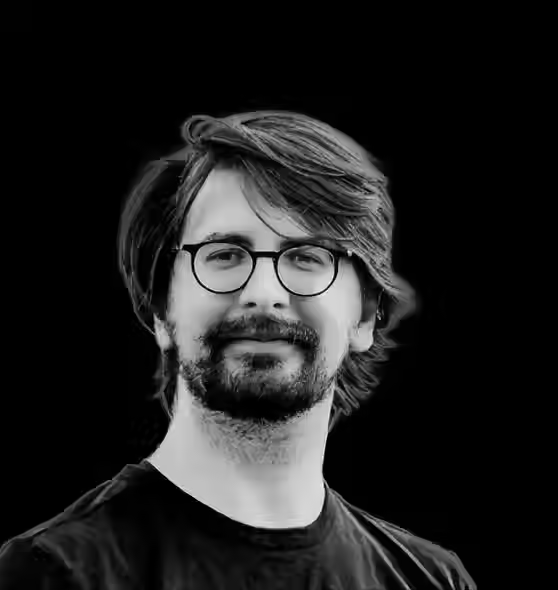
Co-Founder
Alex Djedovic
Prof. Djedovic met Bear at the University of Toronto and share academic passions, particularly in Buddhist philosophy, cognitive neuroscience, embodied cognition, and the philosophy of biology.
Alex and Bear are drawn to emergent questions of AI safety and agency, asking how natural and artificial systems generate cognition. is
Alex is a Professor at the University of Toronto and a cognitive scientist and philosopher specializing in cognitive neuroscience, philosophy of biology, and AI ethics.

Co-Founder
M. "Bear" Ramsay-St Claire
Bear just returned from Yale and Oxford and met Alex at the University of Toronto. Our co founders shared similar academic passions, particularly in Buddhist philosophy, cognitive neuroscience, embodied cognition, and the philosophy of biophysics and artificial intelligence and quantum computing
Bear and Alex are drawn to emergent questions of Artificial Intelligence safety and agency, and asking how natural and artificial systems generate cognition and could work together.
Bear is the Founder, CEO, Sr Engineering Scientist at rQBIOAI Labs, where he leads research into next-generation quantum energy physics stabilization, quantum computing and quantum bio-artificial intelligence engineering and deep space systems engineering
.
Meet our Alumni

Chante Brown
Lab Co-Ordinator
Chanté Brown is an emerging researcher in Cognitive Science and Bioethics at the University of Toronto, with a growing portfolio in neuroscience, applied psychology, and AI-aligned research. .

Jack Du
Lab Co-Ordinator
Zhongxinyao (Jack) Du is a fourth-year undergraduate student pursuing a double major in Biology and Health and Disease. With a strong interest in the intersection of neuroscience, psychology, and molecular biology, Jack explores how Buddhism psychology and anatomical perspectives contribute to understanding depression and anxiety.

Mason MacMurray
Mason MacMurray-Ramsay is a recent gradate of the University of Toronto with Hons Political Science Major, and History and Urban Studies Minor.

Janet Pham
Psychology, Neuroscience Major, and Buddhist Psychology and Mental Health Minor
Janet Pham is completing a Psychology Specialist, Neuroscience Major, and Buddhist Psychology and Mental Health (BPMH) Minor at the University of Toronto.
A unique interdisciplinary combination that reflects her deep commitment to understanding the brain, mind, and human flourishing.

Luis Akins
Louis Akins studied Cognitive Science at the University of Toronto, specializing in perception, attention, and memory, alongside deep explorations into mindfulness-based practices and Buddhist traditions.
His research has focused on treatments for substance use disorders and trauma-related feedback loops, integrating perspectives from predictive processing, affective neuroscience, and embodied cognition.

Vic Perematko
Vic is a University of Toronto alumni, with a degree in Cognitive Science specializing in computational cognition.
Vic's academic journey explored the intersections of consciousness, machine learning, neuroscience, and the history and philosophy of science.
Vic is interested in how neuroscience and cognitive modeling can illuminate the nature of human experience and translate into how we build and relate to artificial intelligence.

Moaz Saber
Moaz Saber is a fourth-year undergraduate student at the University of Toronto, pursuing a double major in Human Biology and Nutritional Sciences with a minor in Drama.
His academic focus centers on neuroscience and neurodegenerative diseases, with a strong interest in how fatty acid metabolism and nutritional interventions impact brain function and cognitive decline.

Nicolas Viulet
Nicolas Viulet is a fourth-year undergraduate student pursuing a Specialist in Neuroscience with a minor in Buddhism, Psychology, and Mental Health.
His research interests focus on altered states of consciousness, mental health, and the ethics of emerging technologies.

The CARRE Lab
Cognitive Neuroscience, Artificial Intelligence, Agency, Reflection, and Ethics

Eight Part Seminar Series
2025 to 2026
The CAARE Lab grew out Alex and Bears conversations that that Scientists must be prepared encounter and re-think about nature's unseen aspects, and begin reconsidering the human, the technological, and the biological as separate.
Our challenge as scientists is challenging the boundary between biological and artificial intelligence, and approaches cognition as embodied and emergent. Today emergent questions of AI safety and agency, and asking how natural and artificial systems generate cognition are critical questions that must have answers.

Quantum Artificial Intelligence, Great Chain of Being, Neo-Colonialism, Human Machine Co-consciousness
These session examines Quantum Artificial Intelligence,Quantum Decoherence, Stochastic Noise, and Human Machine Co-consciousness

Artificial Intelligence, Indigenous Futurisms & Human Machine Co-consciousness
These session examine Artificial Intelligence, Indigenous Futurisms. Indigenous Cognitive Sovereignity and the connections of place thought and moral responsibility

Buddhism & Human Machine Co-consciousness & Moral Responsibility Seminar
These session explore Buddhism & Human Machine Co-consciousness and ethical responsibility

Quantum Intrinsic Self, The Burden of Agency and Distributed Quantum Energy Physics
These sessions examines AI Agency emerges as a distributed gradient across biological and artificial systems or a deeper Quantum Physics instatiation found within the fabric of the universe or an artifact straddling the liminality of the ephemeral and physical.

Quantum Neuroscience & Human-Machine
Co-Consciousness, Cognition and Perception Seminars
These sessions explore how Human-MachineCo-Consciousness, Cognition and Perception expand our understanding of perception, revealing modes of awareness that exceed conventional human and biological boundaries. Ethics, Power, and Representation

Quantum Artificial Intelligence, Computational Neurolinguistics & the Ethics of Power, Political Choice and Inclusion Seminars
These sessions examine how the design and deployment of AI encode political choices, reproduce or resist structures of power, and shape who is represented and who is excluded.

Quantum Embodiment, Healing, and Synthetic Identity Seminars
These sessions confront the embodied dimensions of intelligence energy, pain, healing, and grown biological tissue and the ethical questions raised where the boundary between body, self, and synthetic identity dissolves., Authorship, and Moral Responsibility

Quantum Neural Synchrony, Coherence, Interdeterminism, & Quantum Machine Language Co-Consciousness Seminars
These sessions examine the emerging phenomena of Quantum Neural Synchrony, Coherence, Interdeterminism & Quantum Machine Language Co-Consciousness and traces the parallels between human contemplative states and machine language, asking whether AI imitates the recursive loops of consciousness or accesses the same underlying patterns in Quantum Machine Language .

Dhammapada
All that we are is the result of what we have thought: it is founded on our thoughts, it is made up of our thoughts. If a man speaks or acts with an evil thought, pain follows him, as the wheel follows the foot of the ox that draws the carriage.
All that we are is the result of what we have thought: it is founded on our thoughts, it is made up of our thoughts. If a man speaks or acts with a pure thought, happiness follows him, like a shadow that never leaves him.
The Dhammapada, verses 1–2 (The Twin-Verses), trans. F. Max Müller
video.
Müller, F. Max (trans.). (1881). The Dhammapada (verses 1–2). In The Sacred Books of the East, Vol. X, Part I. Oxford: Clarendon Press.
